





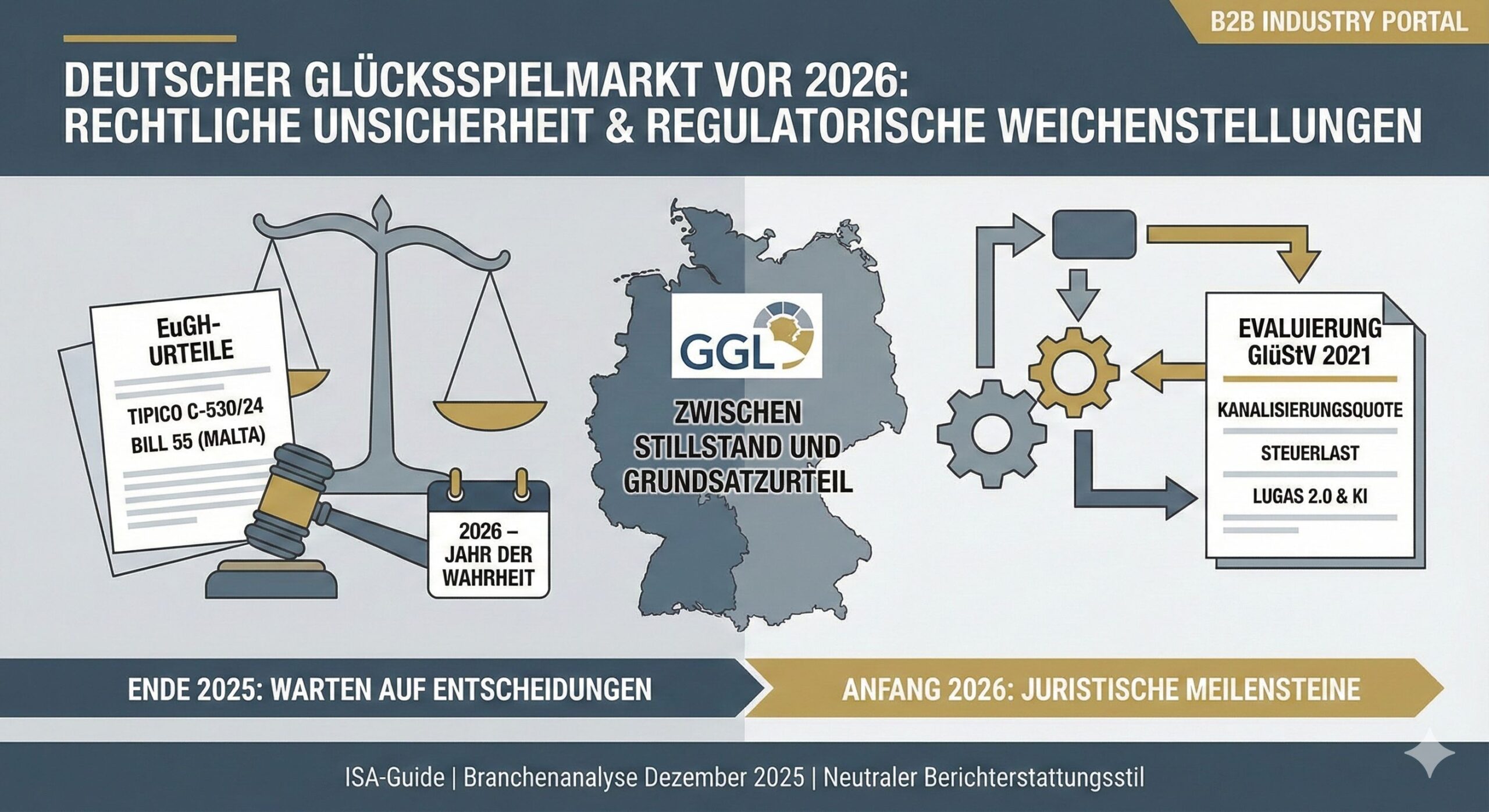
This article examines the current situation on the German gambling market at the end of 2025 and provides a detailed outlook on the regulatory and legal milestones of the coming year. It is written in a neutral reporting style for specialist portals such as the ISA Guide.
Industry analysis: Legal uncertainty and regulatory decisions at the end of the fourth year of the GlüStV 2021
At the end of 2025, the German gambling market finds itself in a paradoxical situation. While the Joint State Gambling Authority (GGL) has consolidated its operational structures in Halle (Saale) and the number of licensed providers remains stable, the industry has entered a phase of legal uncertainty. Anyone seeking guidance in the complex web of national law, European freedom to provide services, and an unprecedented wave of lawsuits will find that almost all landmark decisions have been postponed until 2026. In this uncertain environment, reliable regulatory frameworks for operators, lawyers, and policymakers are becoming more important than ever in order to be able to strategically classify the coming upheavals.
1. The legal vacuum: The ECJ showdown in 2026
The dominant issue in the courtrooms of the Federal Republic of Germany remains the question of recovering gambling losses. Tens of thousands of civil lawsuits against online sports betting and online casino providers are weighing on the justice system. But anyone who had expected clarification in 2025 was disappointed.
The Tipico case: Decision postponed
Particular focus is on the proceedings against the sports betting market leader Tipico (Ref. C-530/24). The Federal Court of Justice (BGH) had submitted questions to the European Court of Justice (ECJ) regarding the conformity of the German licensing model with EU law before 2020. Shortly before Christmas 2025, it was announced that the date for the Advocate General's opinion had been postponed from December to February 2026.
This postponement has far-reaching consequences: Since the BGH has suspended almost all ongoing appeals in this area, there is a de facto “decision freeze” in Germany. Only when the ECJ delivers its ruling in spring or summer 2026 will it become clear whether past contracts were void or whether providers are protected by EU law. For the industry, billions of euros are at stake.
Malta and “Bill 55”: Cracks in the single market?
Another major legal project for 2026 is the review of Malta's “Bill 55”. This law is intended to protect Maltese providers from the enforcement of German judgments. The conflict has long since reached the diplomatic level. In October and November 2025, initial signals from Advocates General at the ECJ (including in case C-198/24) indicated that national protection laws such as Bill 55 are unlikely to be compatible with the EU Recognition Regulation. A final ruling is expected in the first half of 2026. It will decide whether German players can actually convert their hard-won judgments into cash.
2. The 2026 evaluation: a mammoth political project
The 2021 State Treaty on Gaming (GlüStV 2021) contains a voluntary commitment by the federal states: by December 31, 2026, a comprehensive report must be available that assesses the treaty's impact on player protection and channeling.
The channeling dilemma
Recent studies published at the end of 2025 (including data from the University of Leipzig and the DOCV) paint a worrying picture. The channeling rate – i.e., the proportion of players who play in the legal market – is stagnating at around 50 percent. Critics see the cause in the lack of competitiveness of the legal offering.
Tax burden: Economists describe the 5.3 percent wagering tax as a “channeling brake” because it depresses payout rates (RTP) and drives players to tax-free illegal providers. Stake limits: The rigid €1,000 limit, which does not take individual creditworthiness into account, will be a key point of discussion in the 2026 evaluation.
The call for a regulatory compass
Within the political arena, there are growing calls for bold reform in 2026. Without a scientifically sound reorientation—a kind of compass for the period after 2026—the legal market risks losing its protective function. The GGL will have to play a key role here in mediating between the restrictive demands of addiction support and the economic reality of the providers.
3. Technical upgrades: IP blocking and LUGAS 2.0
From May 2026, the GGL plans to tighten technical measures against illegal providers. Internet providers will be increasingly obliged to prevent access to unlicensed sites by means of IP blocking. While the authority sees this as a necessary tool, IT experts and data protectionists warn of overblocking and legal hurdles.
At the same time, the LUGAS system (limit and activity file) is being further developed. The focus for 2026 is on the introduction of AI-based early detection systems. These are intended to recognize pathological gambling behavior based on betting patterns before financial damage occurs. In this context, the legal clarification of the GDPR compliance of this real-time monitoring will be a crucial issue for the administrative courts.
4. Economic consolidation: The market of giants
The economic balance sheet for 2025 shows a significant market shakeout. High compliance costs have led to smaller providers withdrawing from the German market. A further wave of mergers and acquisitions is expected in 2026. The trend is clearly towards large, internationally active corporations that can shoulder the administrative burdens of German regulation.
At the same time, recovery claims are weighing on balance sheets. Analysts are closely monitoring whether companies will have to set aside provisions amounting to millions or whether they will undertake restructuring measures to isolate liability risks, as indicated in the case of Tipico.
Conclusion: 2026 as the year of truth
Looking at developments, it is clear that 2026 is no ordinary calendar year for the gambling industry. It is the culmination of years of legal disputes and political debates.
Let's ask ourselves the question: Where is this leading?
- Will the legal market be given the flexibility and freedom it needs to dry up the black market?
- Will the European courts finally create the urgently needed legal certainty for the past?
- Or will German regulation continue to get tangled up in a web of bureaucracy and enforcement obstacles?
Anyone operating in the industry today needs a clear strategy and a sound compass to navigate through the turbulent year 2026. The decisions that will be made in the major courts over the next twelve months will shape the face of gambling in Germany for the next decade.
We will follow these proceedings objectively for you and provide neutral facts to offer reliable guidance in a market full of uncertainty.
Editorial note: This report presents the legal and regulatory situation as of December 2025. The dates given for ECJ rulings are based on the Court's current publications.
| Procedure | Topic | Status (12/25) | Date | Relevance |
|---|---|---|---|---|
| C-530/24 (Tipico) | Sports betting refunds | Final submissions postponed | Feb 2026 | Preliminary ruling for billion-dollar lawsuits |
| C-440/23 (Casino) | Licensing requirement vs. EU | Final submissions available | Q1 2026 | Landmark ruling on consistency |
| C-198/24 (Bill 55) | Malta enforcement | Final submissions (10/25) | H1 2026 | Leverages Malta's protective wall |
| GlüStV 2021 | State treaty review | Evaluation phase | 12/31/26 | Basis for future reforms |
Analysis of the timeline: A decisive six months
As the table shows, the most important decisions will be made in the first half of 2026. For the industry, this means:
Q1 2026: The foundation will be laid with the ruling in case C-440/23. This will determine whether the ECJ considers the German argument on addiction prevention to be “coherent” enough to justify service bans.
Q2 2026: The Tipico case is the real “game changer” for the sports betting market. The postponement of the opinion to February shows the complexity of the matter. A ruling in early summer would coincide precisely with the preparations for the major evaluation of the State Treaty.
Mid to late 2026: Clarification of Bill 55 is the final building block. Even with player-friendly rulings in the other cases, practical enforcement of the claims would remain difficult without overturning the Maltese protective wall.
For specialist reporting, it should be noted that the judiciary has used 2025 to sort through the arguments. 2026 will be the year of execution. Providers must prepare for two scenarios: Either a massive wave of provisions in the event of a negative outcome, or a phase of legal consolidation if the ECJ grants the German authorities more leeway than the plaintiffs' lawyers had hoped for.
In combination with the upcoming evaluation of the State Treaty on Gaming at the end of 2026, it is clear that the industry is facing its biggest turning point since 2021.
Want to stay up to date? Subscribe to our newsletter and follow us on LinkedIn, X, and Facebook.