





In practice, however, the design, scope, and effectiveness of these schemes vary considerably. Some countries rely on comprehensive national registers that cover all legal offers – whether land-based casinos, slot halls, or online platforms. Others limit self-exclusion to specific segments (e.g. online gambling only, or just casinos). And there are markets where self-exclusion hardly exists in law at all – only voluntary, often isolated programs operated by individual providers.
 Different global approaches
- In Europe, the trend is clear: centralized registers with mandatory checks. Germany (OASIS – statistics now available online,Denmark (ROFUS), or the Netherlands (Cruks) have introduced systems that are binding for all licensed operators, effectively closing loopholes that allow players to switch providers despite being blocked.
- In the United Kingdom, the GAMSTOP system consistently covers the online sector, while land-based casinos and betting shops use separate procedures. The coverage is broad, but not fully integrated.
- In Asia, the models are often stricter or more complex: Singapore combines voluntary self-exclusion with statutory exclusions (e.g. for bankrupt individuals) and even allows family members to apply for a ban. Macau combines self-exclusion with third-party applications, though limited to a maximum of two years.
- In classic gambling hubs like Nevada (Las Vegas), there is still no central state self-exclusion system. Players can only exclude themselves from individual properties, and the state’s “Excluded Persons” list is mainly aimed at cheats or offenders – not problem gamblers.
- In Australia, BetStop was launched in 2023 as a national online register, but integration of land-based offers such as lotteries, Keno, or clubs is still pending. This shows the tension between federal structures and national consistency.
Further ISA-GUIDE Reading
- OASIS: Statistics now available online
- An initial assessment of German gambling regulation (GlüStV 2021)
Why self-exclusion matters
The effectiveness of exclusion systems strongly depends on how comprehensive and binding they are:
- The more centralized and cross-channel, the fewer escape routes players have.
- Minimum exclusion periods (e.g. 6 months in NL/UK) prevent quick reversals and strengthen protection.
- Systems with family or statutory exclusions go one step further, as they also protect players who would not apply for a ban themselves.
Conclusion: A patchwork with frontrunners
Globally, self-exclusion remains a patchwork: while countries like Germany, Denmark, the Netherlands, or Singapore are among the frontrunners, other hotspots such as Las Vegas or parts of Australia lag far behind. Depending on the jurisdiction, players face very different realities – from comprehensive protection systems with hundreds of thousands of registrations to fragmented solutions that leave significant loopholes.
Germany (OASIS)
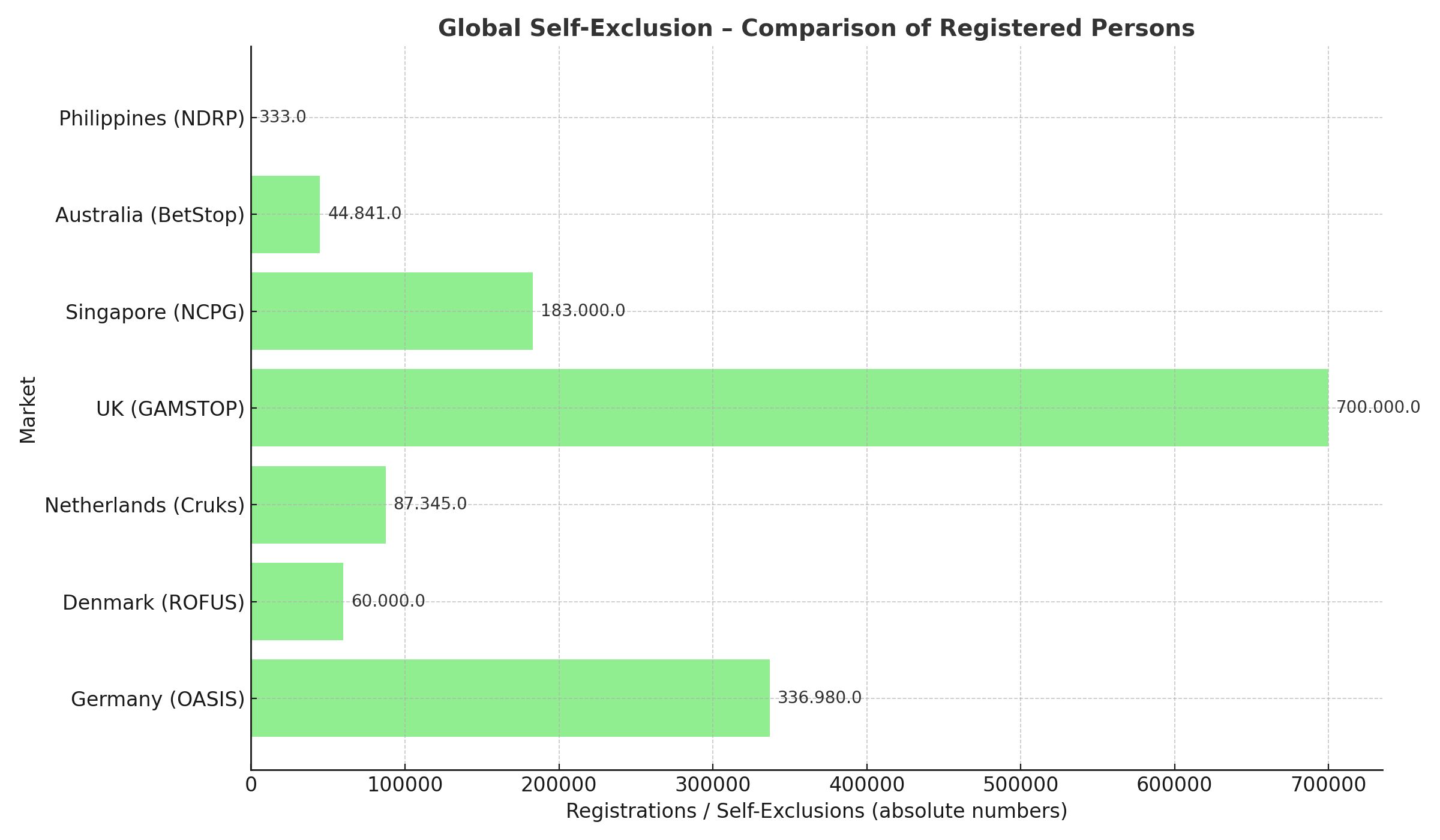
OASIS covers all licensed gambling offers (online and land-based). By July 2025, it recorded 336,980 registrations. Most popular: one-year bans. Options include 24-hour “cool-downs” and very long exclusions (5–10+ years). Monthly growth: 7,300–9,600 new entries, while cancellations are declining.
Denmark (ROFUS)
The Danish Gambling Authority runs ROFUS, mandatory for all licensees. By May 2025, more than 60,000 players had registered. Growth is supported by mandatory operator information and national campaigns.
Netherlands (Cruks)
Cruks is checked by every legal operator (online & land-based). The Kansspelautoriteit reports steady growth: 87,345 registered (Jan 2025) vs. 75,334 (June 2024). Minimum exclusion period: 6 months.
United Kingdom (GAMSTOP)
GAMSTOP covers all licensed online operators. In 2024, a record 99,186 new registrations were added; now over 1% of the UK population is enrolled. Registrations among under-25s are rising sharply.
Spain
Regulator DGOJ complements exclusion with AI-based risk monitoring (~60 behavioral indicators). Its Safe Gambling 2026–2030 strategy aims at early intervention.
Singapore (NCPG)
Multi-layered scheme via the National Council on Problem Gambling (NCPG): casinos, slot machine rooms, and online betting (Singapore Pools). Includes statutory exclusions (e.g. bankrupts, welfare recipients) and Family Exclusion Orders. By end-2024, ~182,954 casino bans were active, plus tens of thousands in online/slots.
Australia (BetStop)
National BetStop register launched Aug 2023 for online & phone betting. By mid-2025: 44,841 total registrations, 30,032 active. Extension to retail lotteries and Keno is under debate.
Philippines (PAGCOR / NDRP)
Regulator PAGCOR manages the National Database of Restricted Persons (NDRP). In 2022, 333 exclusion requests were filed (+62% YoY). Quarterly reports detail self-, family-, and operator-initiated bans.
Nevada / Las Vegas
No statewide exclusion system. Players must rely on property-level bans. The state’s “Excluded Persons List” mainly targets cheats and criminals, not addicts.
Macau
The DICJ allows self- and third-party exclusion, maximum two years. Applications can be filed via Responsible Gambling Kiosks. However, public statistics on volume are limited.
Monaco (Monte Carlo)
Unique model: Monégasque citizens are barred by law from entering casinos. Visitors can self-exclude via written request. Casinos may also ban patrons for “undesirable behavior.”
Global Comparison – at a Glance
| Market | Central register? | Coverage | Minimum duration | Latest figures |
|---|---|---|---|---|
| Germany (OASIS) | Yes | Online & land-based | 24h to >10 years | 336,980 (Jul 2025) iGB |
| Denmark (ROFUS) | Yes | Online & land-based | 24h to permanent | >60,000 (May 2025)spillemyndigheden.dk |
| Netherlands (Cruks) | Yes | Online & land-based | ≥6 months | 87,345 (Jan 2025) kansspelautoriteit.nl+1 |
| UK (GAMSTOP) | Yes (online) | Online only | 6m / 1y / 5y | >1% population iGB |
| Singapore (NCPG) | Yes | Casinos, slots, online | ≥12m, statutory too | ~183,000 (2024, casinos) Default |
| Australia (BetStop) | Yes | Online/phone betting | Flexible | 44,841 total (mid-2025) acma.gov.au |
| Philippines (NDRP) | Yes | Casinos, e-games | Varies | 333 requests (2022) pagcor.ph |
| Nevada | No | Property-level | – | n/a Nevada Current |
| Macau | Yes | Casinos | Max 2 years | no published figures 澳門特別行政區政府入口網站 |
| Monaco | Special regime | Citizens barred, visitors optional | – | no statistics Monte Carlo SBM |